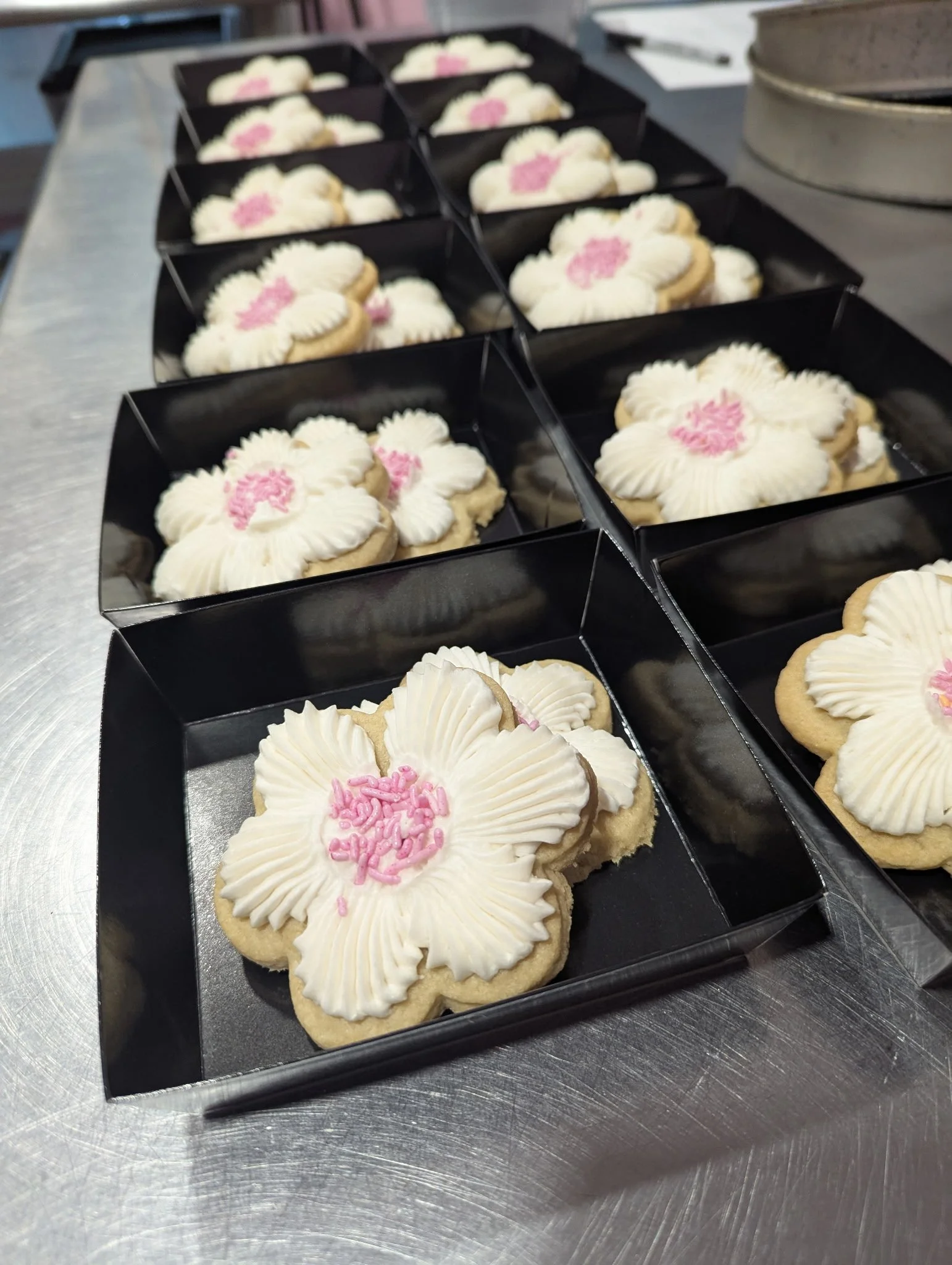
Packaging sugar cookies for a market.
Most people see the baking. Very few see what surrounds it.
The highlight reel of every baker’s social media shows finished products, packed markets, and adorable packaging. All this is just a tiny fraction of the work involved in any bakery. That adorable packaging took me three hours to find online 4 weeks ago and then it took it me 2 hours to get one item packaged and labeled for a video or a market.
The Work That Happens Before Anything Is Baked
Before I ever get to a market, I’ve worked 40 hours or more. This is my full-time job.
Every week starts with printing orders due that week and then laying out a bake schedule. Timing is important with baked goods because some items need a few days. For example, jams have to be made and set up (overnight) before you can use them in a toaster treat. And the pie dough for the toaster treat has to be ahead of time as well and rolled out still cold. My allergen free layer cakes are best frosted when frozen, which means I cannot make them the day they are due. So, taking last minute orders all depend on what you need to order.
Then there is quantity to deal with. How big will this market be? Is it February market (slow) or a June market (huge)? How many chocolate items were already ordered versus what I should bring? Will this week require one batch of vanilla cake or three? Did I order enough flour, sugar, powdered sugar, palm oil shortening, etc? My ingredients aren’t always local and only about half of my customers currently understand that.
Do I have shipping orders this week? Wholesale orders? Home pick ups? Market pick ups? Every week is ideal for Type A nutjobs like me who are great at organization. I love it. The part where I lose it is when my organization is perfect, being executed as I imagined it would be, and someone forgot their spouse’s birthday and needs a cake tomorrow. It throws off the whole system. Last minute orders are definitely easier to pull off when it’s not also Thanksgiving or Christmas. But I try to take them as much as I can because where else are they getting a cake? Not that many places.
Sometimes, I start planning and it seems like a fun week and sometimes I have instant panic attacks about when I’ll actually sleep. This is what happens long before an oven turns on.
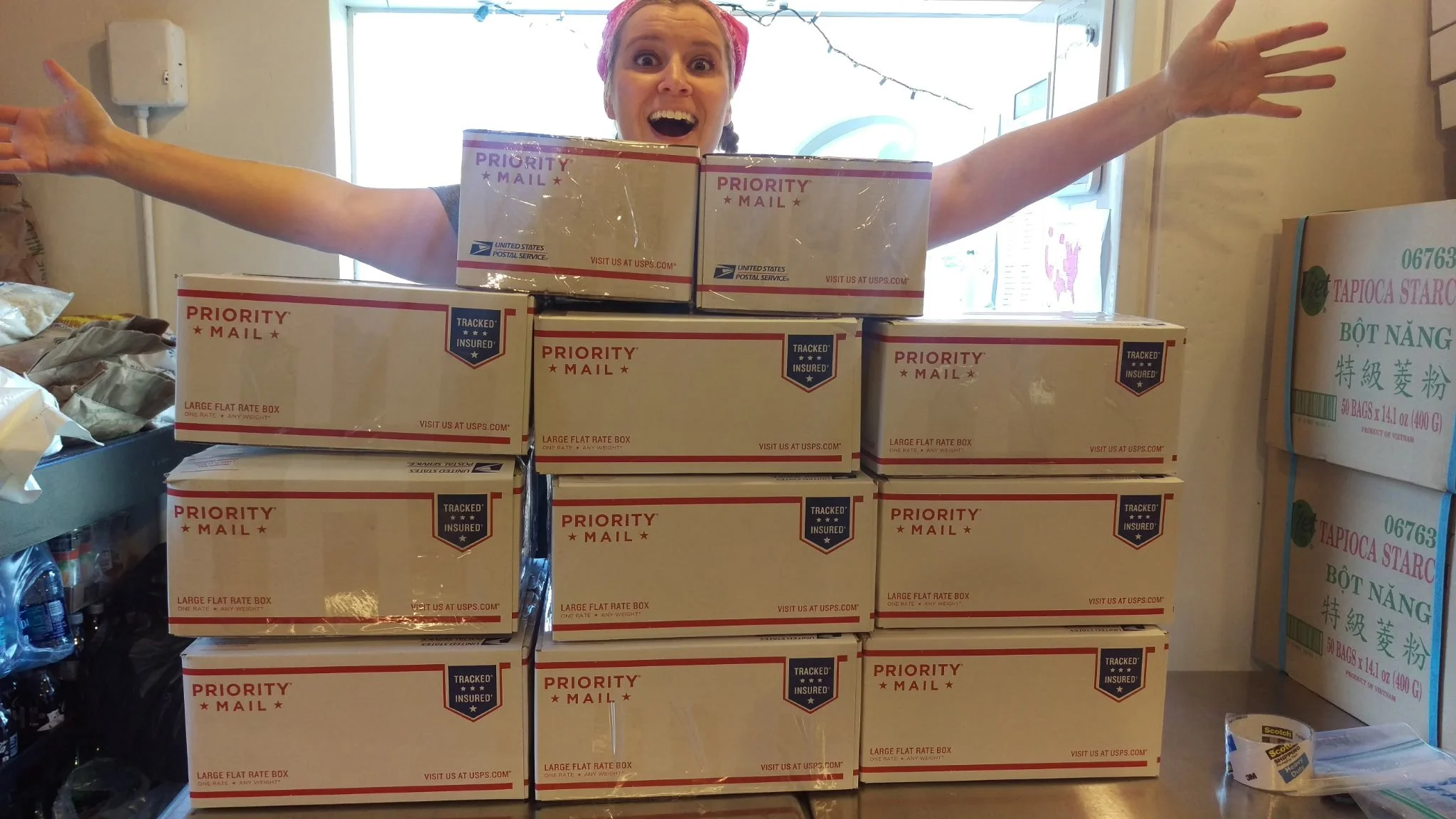
Shipping out to everyone!
The Emotional Labor of Feeding People
There’s also an emotional layer to this work that’s harder to explain unless you’ve lived it. When you bake for people with food allergies, there is no room for casual mistakes. There’s pressure in knowing that someone is trusting you not just with dessert, but with their health. That responsibility sits with me every time I measure, mix, label, and package.
I care more than I technically have to. I remember who can’t have soy, who reacts to corn, who needs something dairy-free and nut-free, and who just wants the same thing they bought last week because it made them feel normal for once. I remember conversations from markets, notes from emails, small details that never make it into an order form. This brain is full of information.
None of that shows up in a cute Instagram photo. But it’s always there.
What a “Slow” Week Actually Looks Like
From the outside, a slow week might look like time off. Fewer orders, fewer markets, fewer posts. But slower sales don’t mean nothing is happening.
Slow weeks are filled with admin work (did I update Quickbooks in the last 6 months?), recipe testing, inventory checks, cost calculations, and planning ahead for weeks that will inevitably be busy again. They’re when I clean up systems, catch up on emails, adjust schedules, and try to make future weeks a little less chaotic.
They’re also when uncertainty creeps in. Will next week pick up? Did I plan correctly? Did I miss something? You keep moving anyway, because this work requires staying ready.
Quiet weeks are maintenance weeks.

Why This Work Matters (Even When It’s Invisible)
All of this invisible work is what allows consistency. It’s how customers know they’ll get the same quality every time. It’s how trust is built, slowly and quietly, over weeks and years.
This kind of work isn’t flashy, but it’s sustainable. It’s what lets me show up week after week, even when things are slow, even when markets get canceled, even when the algorithm doesn’t care about showing you all the cute things I made.
The baking is important. But the work around it is what makes the baking possible.
Pulling Back the Curtain
I’m not sharing this for praise or sympathy. I love this work, even on the hard days. LOVE. I’m sharing it because so much labor goes unseen, not just in bakeries, but in small businesses everywhere.
This is just a gentle reminder that behind every finished product is planning, problem-solving, and a lot of care that never makes it into the highlight reel.
And that work matters too.