The Gluten Free Inventory Problem
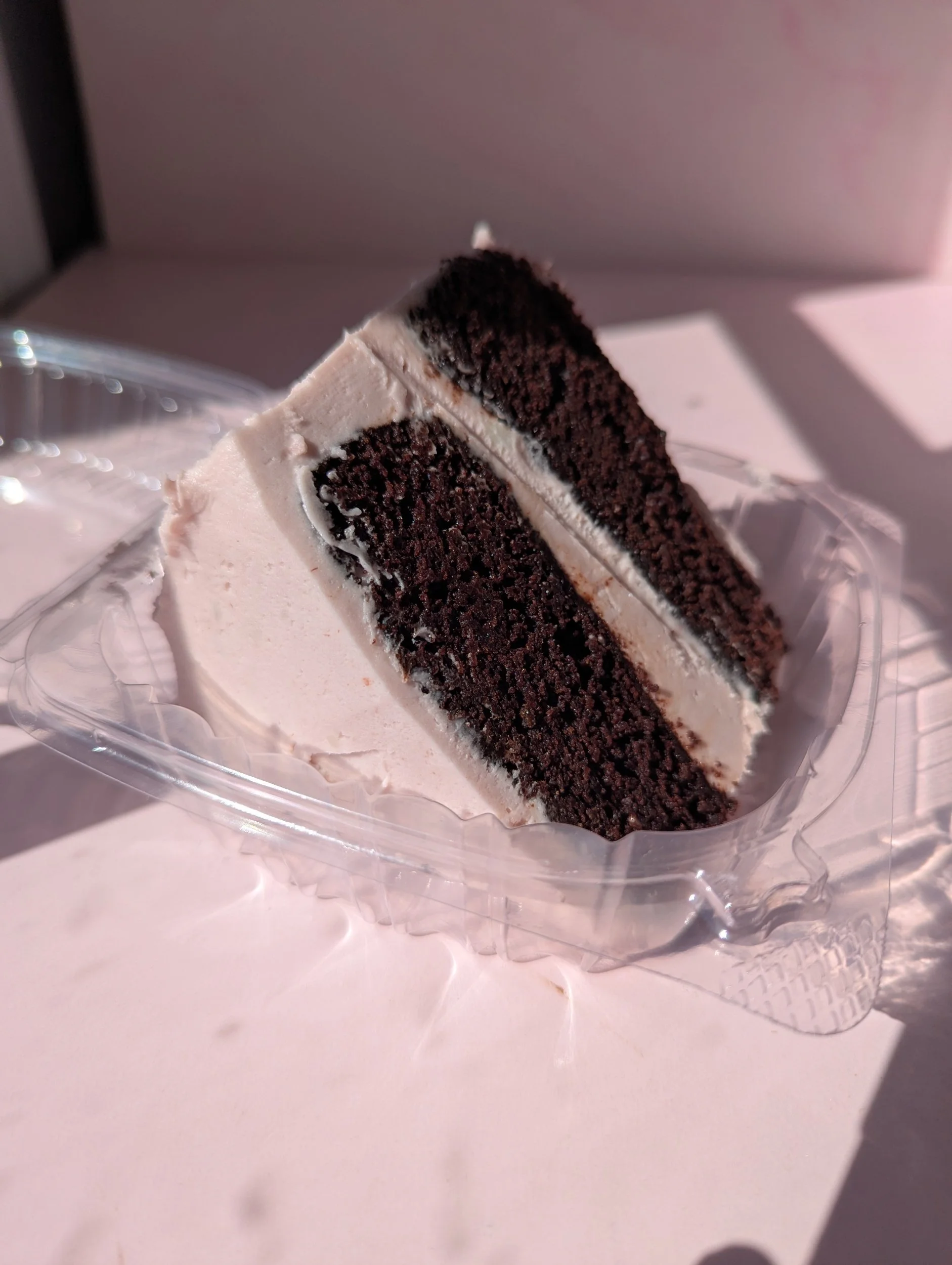
Chocolate cake with raspberry frosting
There’s a common assumption that running out of ingredients in a bakery is a minor inconvenience.
You run out of flour?
You go to the store.
You run out of sugar?
You grab more on your way home.
Problem solved.
That works—if you’re a regular bakery.
Gluten-free baking doesn’t work like that.
Most of my ingredients are not available at a standard grocery store. Sure, they have a few GF flours on the shelf, but not necessarily the ones I use. Plus, the bags are typically 1-2lbs of flour and I go through over 150lbs of flour a week. Buying the grocery store bags would really blow the budget for a home bakery. Bakeries make pennies on the dollar not dollars on the dollar. I need to scrape every penny out of the price of something.
So if I run out of an item, I don’t “run to the store.” I place an order and wait. I’m paying for shipping on a bulk item (typically) and I’m hoping nothing gets in the way of me and the delivery driver for the next five days. His name is Geannis and he’s always smiling in his FedEx truck. He puts the heaviest boxes right by my front door so I don’t have to struggle too much when deadlifting a 50lb box from my porch to my living room.
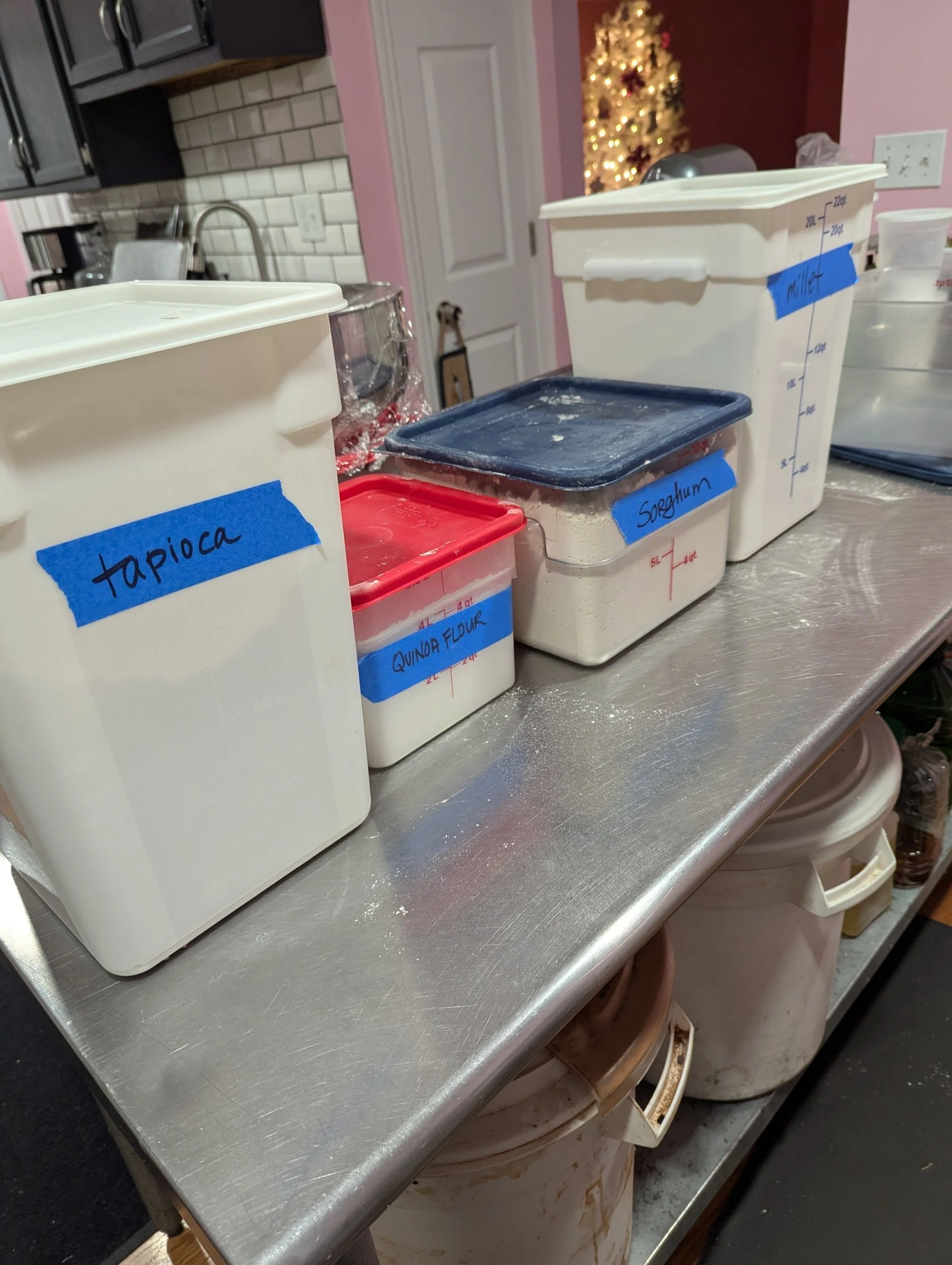
The flour bins that hold the 25lb bags of flour that I get delivered,
One Ingredient Is Never One Ingredient
In a traditional bakery, running out of one ingredient might affect one product.
In a gluten-free bakery, one ingredient can affect most of the menu.
If I run out of palm shortening, any one of the individual flours, or rice milk, that shuts down 95% of the menu. It’s happened before (during covid fun times- eyeroll) and you have to get really creative while you wait for things to show up and make up new menu items with what you have left.
Luckily, I’m a Planner
Inventory isn’t just a weekly task. It’s constant.
I have to think ahead:
What markets are coming up?
What orders are already placed?
What tends to sell more in certain seasons?
How much product do I need versus how much I might need?
Every Monday, I lay out the full schedule of that week’s orders on my white board. I double check ingredients and make a list based on what I need this week and what I’ll need next week (base ingredients). Some of the base ingredients take a while to arrive, so I order them if I have enough money in the bank at the time (bulk ingredients are not cheap). I typically have $4000 worth of packaging and ingredients in my home bakery at any given time. They fill up one entire 10×10 bedroom that I now call the pantry. That’s $4000 that could be in my bank account if I could just “run to the store” and grab what I need. So I start every week at -$4000 and make about half of it back if I’m lucky.
It’s a stupid business operation for sure. Everyone who doesn’t run a food business would tell you to leave immediately and shut it down. But no one runs a food business to get wealthy. The wealthy start food businesses with celeb chefs so they can use it as a tax write off and take it as a loss. And the non-wealthy (me) just love doing it. Do I curse myself every day for not loving the stock market or something lucrative instead? Absolutely. But life is too short to work a job you hate, so the consequence is being poor.
There’s always a balance between:
ordering enough
not over-ordering (spoilage)
and hoping everything arrives when it should (because, you know, someone ordered an item that needs it)
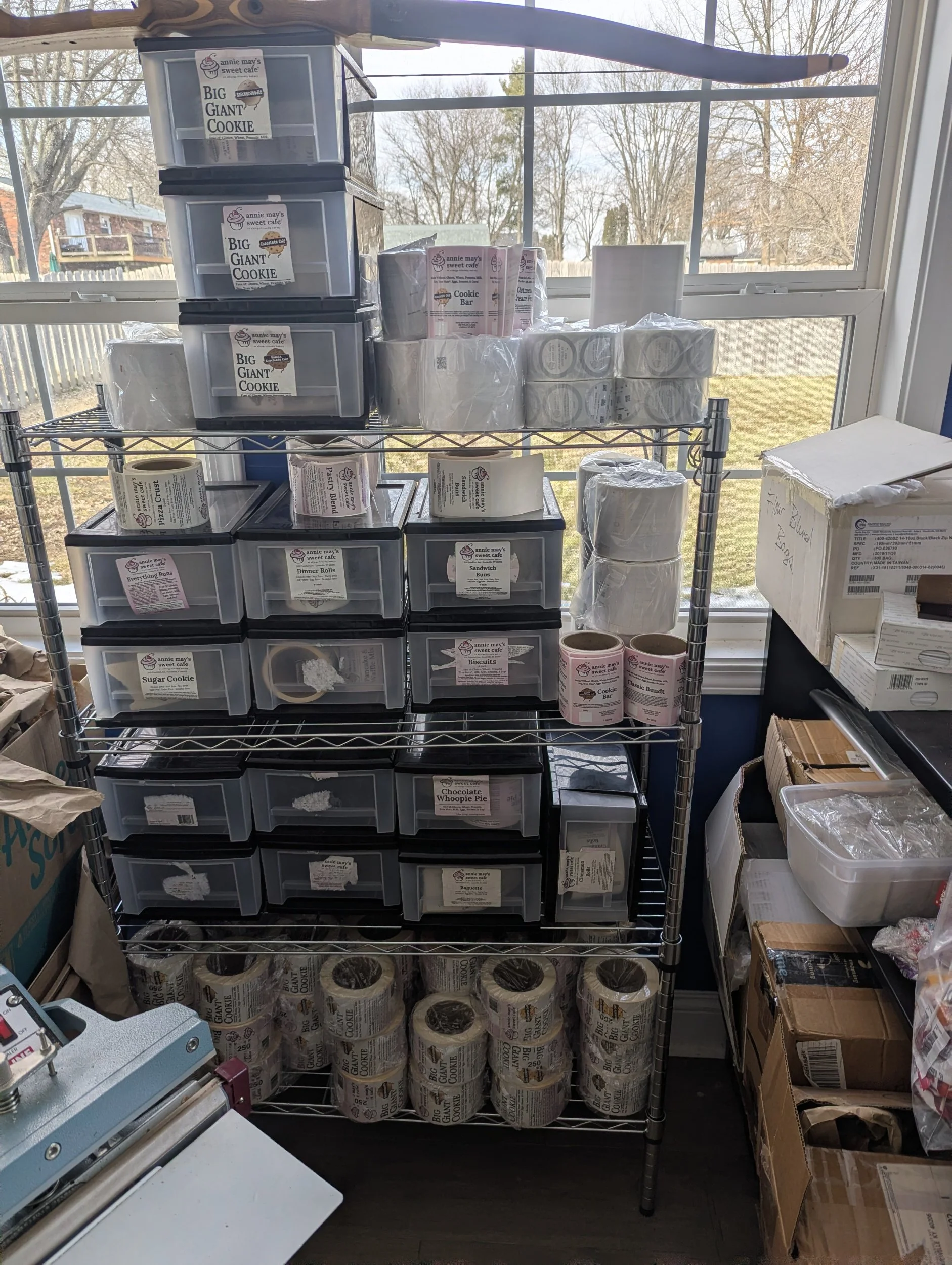
A small portion of my sunroom has the heat sealer, all the labels, and some bags I use for breads, etc. This picture is over $3000 worth of labels, some of which I moved home from the retail shop.
Sometimes (always) Things Don’t Go As Planned
Shipping delays happen.
Suppliers run out of stock.
Orders arrive late or incomplete. Or worse…..rotten/open already/moldy.
And when that happens, there’s not always a quick fix.
You can’t substitute freely in gluten-free baking and expect the same results. Small changes can completely alter texture, structure, and taste.
So sometimes the solution isn’t “adjust the recipe.”
Sometimes the solution is:
don’t make the item
adjust the menu
or explain to customers why something isn’t available that week
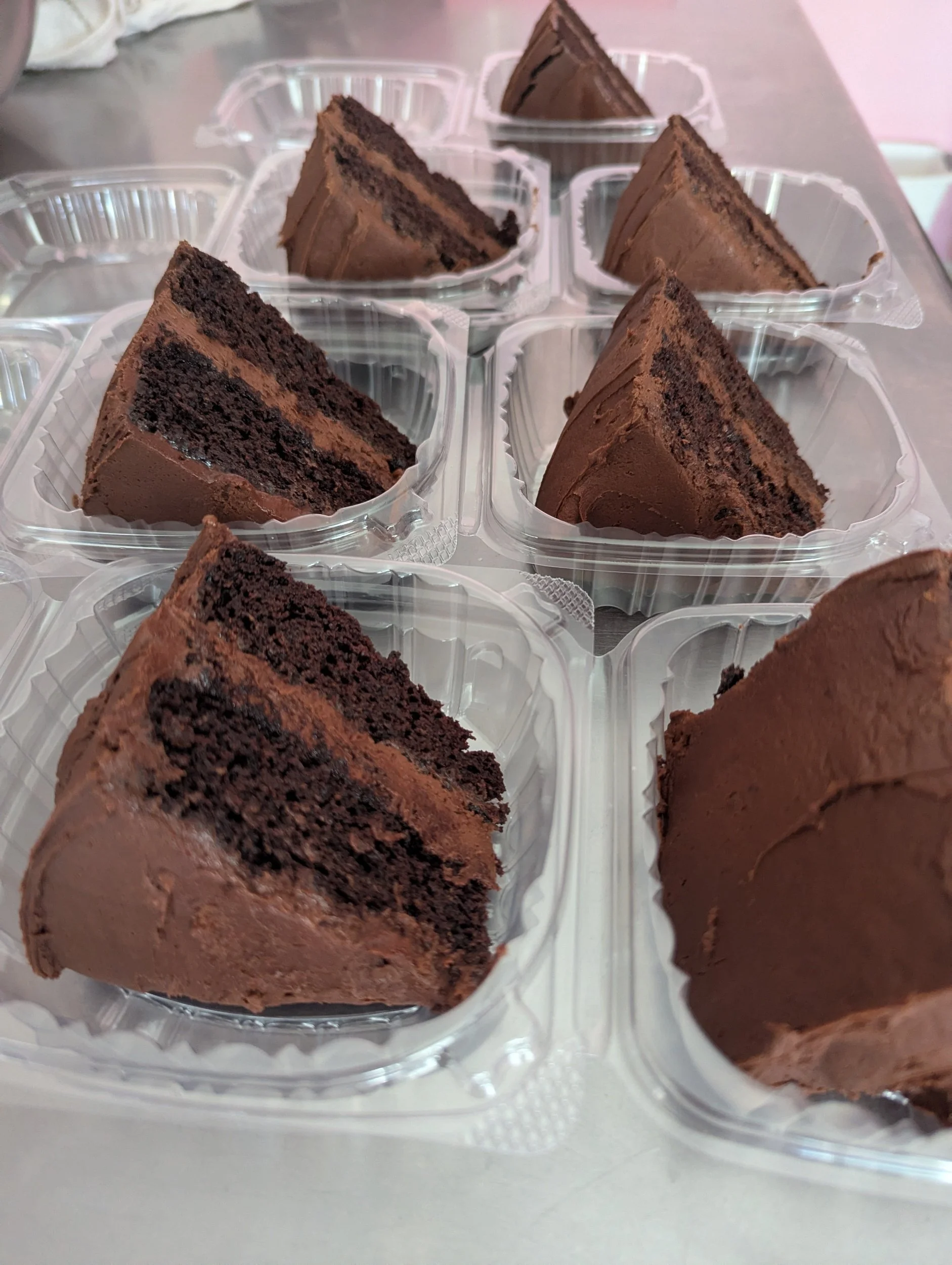
Chocolate cake at the market AGAIN? That’s because I make multiple layers with every batch of chocolate cake batter (wrap tight and freeze), and this is the quick item to frost when I don’t have time/ingredients to make something else.
This Is What You Don’t See
From the outside, it might look like a bakery just didn’t make enough of something. But behind the scenes, there’s a lot more going on:
sourcing
planning
timing
and a fair amount of guessing
Inventory in a gluten-free bakery isn’t flexible. It’s structured, and it has to be.
The Quiet Part of the Job
This is one of those parts of running a bakery that no one really sees.
It’s not the baking.
It’s not the decorating.
It’s not the finished product.
It’s the planning that happens before any of that starts.
I spend hours per week baking stuff for orders and markets. My heavy bake days are Mon/Wed/Friday and those days are 12-15 hours of me standing and baking, wrapping items for later, doing mountains of dishes, taking cute pictures, making pounds of frosting, melting chocolate, did I say doing mountains of dishes? My knuckles bleed year round, honestly.
My Tuesdays and Saturdays are mostly market days, with a bit of baking beforehand. And my Thursday is a half delivery day, short bake day.
Beyond that, I spend my downtime searching for the best price on flour, chocolate, sugar, etc every week. I write blogs on my day off (Sunday). I answer emails, DM’s, and social media comments all day long. I update my Quickbooks and plan out my monthly bills when I’m drinking my morning coffee. I walk on my treadmill and work on the computer if my body allows it that day.
And when it works well, no one notices anything but the baked goods.
Running out of something in a gluten-free bakery isn’t just an inconvenience—it’s a chain reaction. So a lot of the work happens ahead of time, trying to prevent that from happening at all.
Because once the oven is on, it’s already too late to “run to the store.”
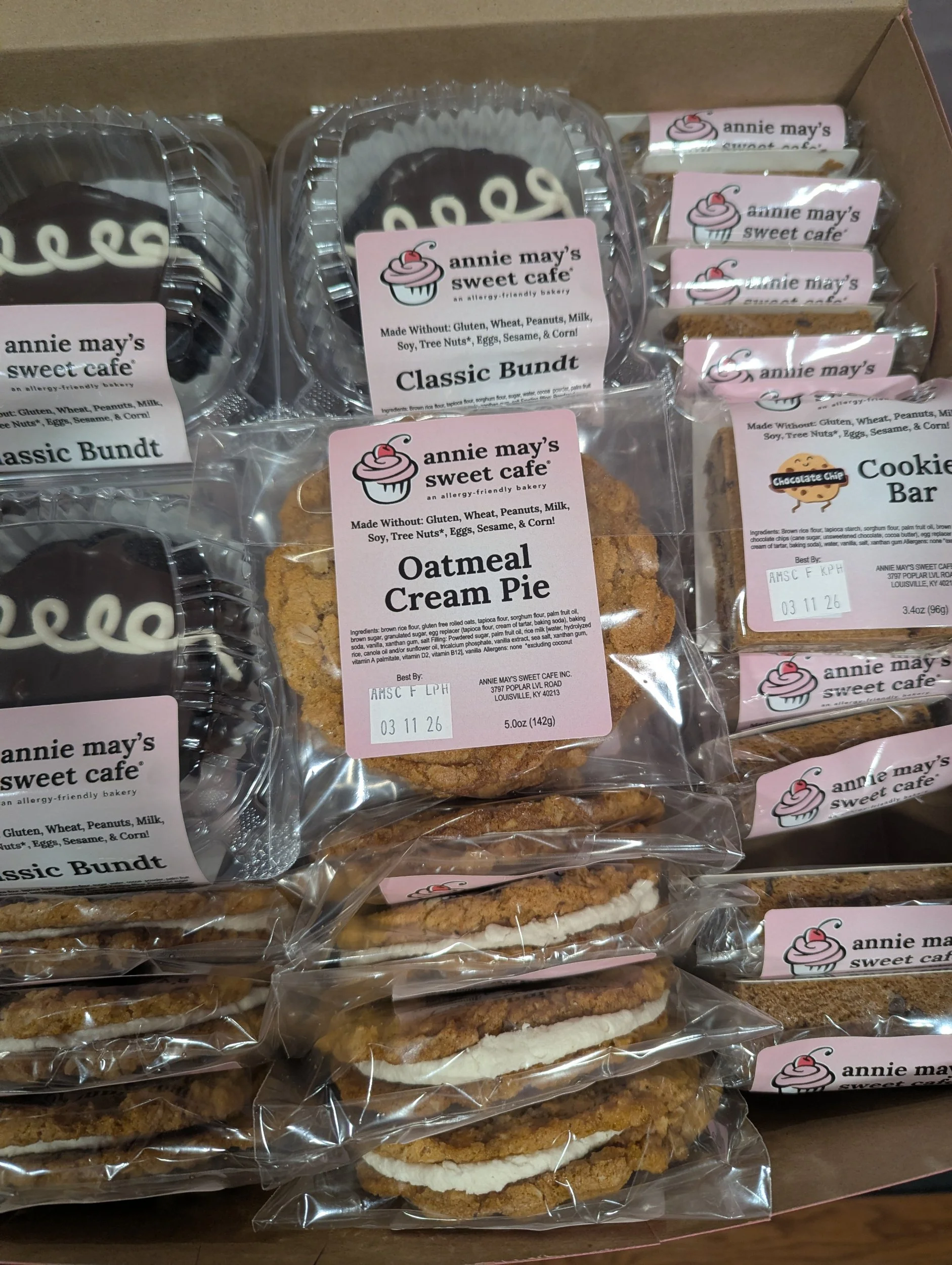
Do you know how long it takes to prep, bake, wrap, heat seal, and label hundreds of baked goods a week? About 20 hours of streaming, so yes, I’ve seen everything ever made.